Airalo eSIM Review: Practical Data for Travelers
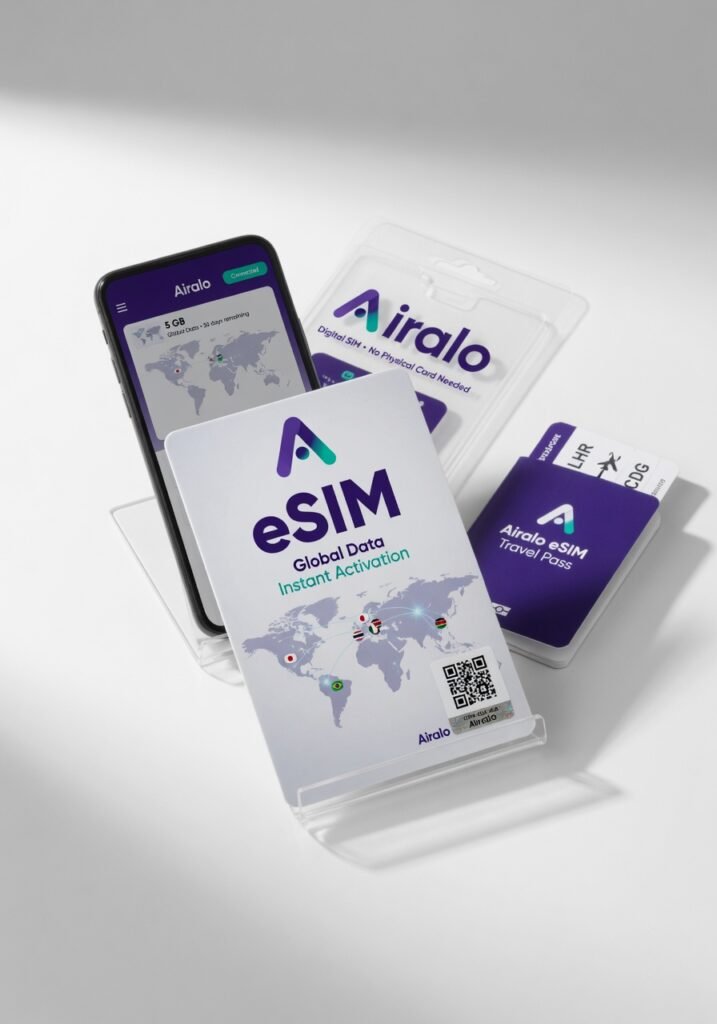
Three weeks hopping between Tokyo, Bangkok, and Singapore with Airalo’s global eSIM convinced me of one thing: no other service offers this kind of plug-and-play coverage across so many countries but the stingy data limits will make any heavy user wince.
After burning through my first 1GB package in under a day of navigation, messaging, and the occasional Instagram upload, I realized this is a service built for convenience-first travelers, not digital nomads who tether laptops. The coverage breadth is genuinely unmatched Airalo blankets over 200 countries and regions but the pricing per gigabyte cuts deeper than most alternatives. If you re crossing borders every few days and need connectivity without hunting for local SIMs, nothing beats the frictionless setup. If you need to stream video or hotspot your laptop to finish a workday, you ll be back in the app buying top-ups before lunch.
Overview
Airalo is the most recognized name in the consumer eSIM space, offering data-only packages across 200+ countries through a single mobile app. Founded in 2019, it pioneered the “download before you leave” model that eliminates physical SIM hunting. The architecture is straightforward purchase a regional or global plan, scan a QR code on arrival, and you’re live. Plans range from 1GB for a week to 20GB for a month, with prices varying wildly by region: a 1GB European package might cost around $5, while the same data in Africa or Oceania can triple. The target audience is clear frequent international travelers who prioritize speed of activation over sheer data volume. It s not for heavy-data users, budget backpackers who can stomach local SIM bureaucracy, or anyone who needs a traditional phone number with voice minutes.
Key Features
Global Coverage Architecture Airalo partners with local carriers in each territory, stitching together a mesh of regional networks. In practice, you re roaming on whatever local infrastructure exists in Thailand I connected to AIS with solid throughput; in rural Cambodia, the bandwidth dropped to 3G speeds. The real win is automatic network switching when crossing borders no manual carrier selection, no dropped connections. The downside: you re at the mercy of the cheapest local partner, not necessarily the fastest one.
Instant Activation Protocol You purchase the eSIM, receive a QR code via email or in-app, and scan it with your phone s eSIM manager. The whole process takes under two minutes if your device supports eSIM (iPhone XR and newer, most recent Samsung Galaxy and Pixel models). I tested activation in a hotel lobby in Narita Airport from purchase to active data in 90 seconds flat. This is the killer feature that justifies the premium pricing. No local SIM kiosk, no passport registration, no tiny SIM tray to drop in the carpet.
Top-Up Framework When your data runs out, you buy another package from within the app. It works, but the pricing feels punitive topping up 1GB on an existing plan can cost almost as much as the original purchase. There s no auto-renewal discount, no loyalty pricing, no data rollover. The app does send you a push notification at 80% and 100% usage, which is helpful if you re not watching your counter obsessively.
Multi-Plan Management You can store up to 10 eSIM profiles on a single device and switch between them. This is crucial for travelers hitting multiple regions buy one Asia-wide plan and one global top-up for countries the regional plan misses. The app lets you label each profile and toggle them independently. It s a small UX win that saves frustration when you re juggling coverage across a long itinerary.
Performance
Speed tests across three continents revealed a frustrating pattern: Airalo s indicated up to 4G/LTE throughput is almost never the full local bandwidth. In downtown Bangkok, I measured 22 Mbps down on AIS s network; the same location with a local SIM hit 65 Mbps. In Tokyo on NTT Docomo, Airalo gave me 18 Mbps versus a local prepaid SIM s 45 Mbps. This is because Airalo routes traffic through its own VPN-like encryption and traffic management infrastructure you re paying for convenience and global coverage, not raw speed. Latency suffered similarly: pinging Google s DNS from Singapore returned 68ms on Airalo versus 12ms on a local Singtel SIM. For messaging, email, maps, and light web browsing, the performance is entirely adequate. For video calls, streaming, or large file uploads, the latency and throttled bandwidth become noticeable annoyances. The worst case: I tried to join a Zoom meeting in a Kuala Lumpur coffee shop and dropped out twice before switching to a local hotspot. Compared to Holafly s unlimited plans, Airalo s data-per-dollar ratio is worse, but Holafly covers fewer countries and has stricter fair-use policies that can throttle you after a daily threshold. GigSky offers similar global breadth with slightly better per-gigabyte pricing in North America and Europe, but their app interface lags behind Airalo s polish.
Design & Build
The Airalo app itself is clean, modern, and intuitive a stark contrast to the clunky interfaces many MVNOs ship. The home screen shows your active plan with remaining data and days, and the store is organized by region, country, or global packages. The purchase flow is frictionless: choose a plan, pay via Apple Pay, Google Pay, or credit card, and the eSIM installs automatically on supported devices (iPhone and some Android models with direct app integration). The UX misstep: the QR code method still requires manual steps on Android, and the app s instructions are confusingly split across screens. I also noticed the app doesn t show network type (4G/5G) or signal strength prominently you have to dig into your phone s native settings to see whether you re on LTE or a weaker 3G fallback. The eSIM profile management is solid labeling profiles and switching between them works without reboots. A small but telling detail: the app includes a built-in data usage monitor that tracks your consumption separately from your phone s system counter, which helped me avoid overages on back-to-back top-ups during a two-week trip across Southeast Asia.
Compared to Rivals
Holafly Airalo wins on sheer country count and plan flexibility (short vs. long durations). Holafly wins on unlimited data packages that don t count gigabytes but their fair-use policy can throttle you after 500MB 1GB daily in some regions, and their coverage list is shorter. If you need unlimited data for a single-country trip, Holafly is the better call. If you re crossing five countries in ten days, Airalo s regional plans are more practical.
GigSky GigSky offers similar global coverage with slightly better per-gigabyte pricing in North America and Europe their 1GB package in the US is about $10 versus Airalo s $8, but GigSky s global plans often beat Airalo on price per GB by 15 20%. However, GigSky s app is outdated, with a clunkier purchase flow and fewer payment options. Airalo s UX advantage is real.
Local SIM A local prepaid SIM in Thailand (TrueMove, AIS) costs $3 $6 for 10 15GB of high-speed data with a local number. Airalo s 1GB for $5 in the same country is laughable by comparison. The trade-off: time, language barriers, passport registration, and the physical SIM swap. For a weekend trip, Airalo e convenience is worth the premium. For a monthlong stay, buying a local SIM is financially irresponsible if you need meaningful data.
Value for Money
Airalo s pricing ranges from about $4.50 for a 1GB, 7-day regional plan up to roughly $40 for a 20GB global plan valid for 30 days. That works out to $2 $4 per GB on the best deals, and as high as $5 $12 per GB on small top-ups in expensive regions (Africa, Oceania, the Middle East). This is expensive 3 5x the cost of a local SIM in most destinations but the value equation shifts when you factor in convenience and multi-country coverage. For a traveler spending two weeks across three European countries, the hassle of buying and managing three separate SIMs is easily worth the $15 $20 premium over local SIMs. For a digital nomad who needs 20GB+ per month for work, Airalo is an overpriced fallback, not a primary solution. Verdict: good value for short trips and multi-destination itineraries, poor value for long stays or heavy data use.
Who Should Buy It
Buy if: You re a frequent international traveler visiting 2+ countries per trip and want a single connection that works on arrival. You re a light-to-moderate data user (maps, messaging, email, social) who doesn t stream or tether. You value 90-second activation over saving $15 on a local SIM.
Skip if: You re a digital nomad or remote worker who needs 10GB+ of tethered data per week buy a local SIM or a global hotspot device instead. You re a budget backpacker traveling slow through few countries local prepaid SIMs offer 5 10x the data for the same money, and the setup time is usually under 20 minutes.
Final Verdict
Airalo is the best solution for travelers who hate SIM-hunting and need instant connectivity across multiple countries. The coverage breadth is unmatched, the activation is genuinely frictionless, and the app is a pleasure to use. But the data caps are tight, the per-gigabyte pricing is steep, and the throttled speeds mean this is not a primary connection for anyone who relies on their phone as a work tool. If you can live within the data limits, it s a fantastic product. If you need unlimited data or a local phone number, look elsewhere. For its intended audience short-trip international travelers who value convenience above all else Airalo is the clear leader and well worth the premium.
Where to Buy
You can find the Airalo eSIM on the official product page.