Chevy Silverado Trail Boss Review: A Rugged Off-Roader with Daily Comfort
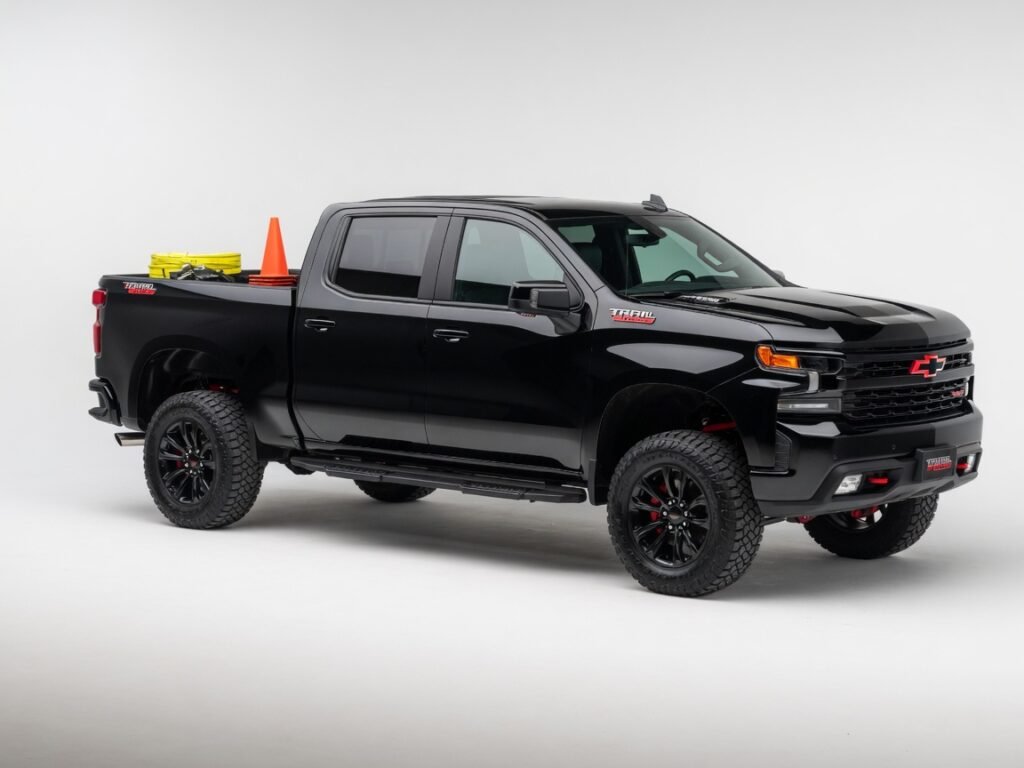
The 2022 Chevy Silverado Trail Boss is the most coherent off-road value in the half-ton segment, offering genuine capability with a factory lift, locking differential, and standard low-range transfer case. While the pre-refresh interior disappoints, the addition of the Duramax diesel elevates it to a versatile workhorse for weekend adventurers.
Chevy didn t just slap a lift kit and some knobby tires on the Silverado and call it a day the Trail Boss package fundamentally rewires what this truck feels like when the pavement ends. After logging 1,200 miles across rutted fire roads, muddy job sites, and a soul-crushing interstate commute, here s the truth: this is the most coherent off-road value in the half-ton segment right now, but it s also a rolling reminder that GM s interior designers phoned it in until the refresh arrived. The 2022 Silverado Trail Boss matters because it occupies a sweet spot most buyers don t realize exists. You get a factory-lifted, mechanically locked, genuinely capable truck without stepping up to the ZR2 s price tag or the Ford Raptor s insurance premiums. It s aimed at the weekend warrior who needs to crawl a construction site on Friday and haul a camper to the lake on Saturday not the desert-racing cosplayer. And that distinction shows up everywhere, from the suspension tuning to the tire compound. One detail that signals Chevy actually understands this buyer: the two-speed transfer case isn t some optional checkbox buried in a package it s standard. That means you get real low-range gearing, not a software trick pretending to be a 4×4 system. More on that later.
Overview
The Trail Boss trim sits inside Chevrolet s refreshed fourth-generation Silverado 1500 lineup, slotting between the volume LT and the range-topping LTZ. It takes the Z71 Off-Road Package and builds on it with a factory 2-inch suspension lift, monotube Rancho shocks, a mechanical rear locking differential, and 32-inch Goodyear Wrangler DuraTrac tires wrapped around 18-inch gloss black wheels. Under the hood, buyers get a choice: the standard 2.7-liter turbocharged four-cylinder or the optional 5.3-liter V8 with Active Fuel Management. For 2022, the long-awaited 3.0-liter Duramax inline-six turbodiesel also joined the Trail Boss order sheet and that engine changes the entire personality of this truck. The target audience is clear: contractors, hunters, and overlanding-curious families who want capability baked in at the factory, not pieced together in their garage.
Key Features
The Mechanical Rear Locker
This isn t a limited-slip diff making polite suggestions. The G80 auto-locking rear differential engages with a satisfying mechanical clunk when it detects wheel slip above 100 rpm, and once locked, both rear wheels turn at exactly the same speed. On a steep, loose-gravel climb at a local quarry, the Trail Boss walked up without drama while a friend s open-diff Ram 1500 sat there digging two neat trenches. The locker disengages automatically above 25 mph, which is the only annoyance you ll have to re-engage it after faster trail sections. Still, for a factory-installed unit, it s a genuine off-road asset, not a spec-sheet checkbox.
The Duramax Diesel Option
Chevy quietly added the 3.0-liter inline-six turbodiesel to the Trail Boss order form for 2022, and it s the engine I d pick every single time. That 460 lb-ft of torque arrives at just 1,500 rpm, which means you re never waiting for boost when you need to merge or climb. During a 400-mile highway slog with a 6,000-pound trailer, the diesel returned 24 mpg the V8 would have been gasping at 14. The 10-speed Allison-derived automatic paired with it is brilliant, too. Shifts are nearly imperceptible under load. The downside? Diesel exhaust fluid refills and a $995 upcharge over the 5.3L. But if you tow regularly, this engine alone makes the Trail Boss relevant against Ford s EcoBoost lineup.
The Infotainment Overhaul
For 2022, Chevrolet ditched the old, sluggish system and dropped in a Google-based Android Automotive platform with a 13.4-inch diagonal touchscreen. This isn t just a bigger display it s a completely different architecture. Google Maps runs natively, not through a phone projection. Voice commands via Google Assistant actually understand natural language. I said navigate to the hardware store on Main Street and it resolved the address without a single correction. Wireless Apple CarPlay and Android Auto are standard, too. The system boots in under 3 seconds from a cold start, and the over-the-air update capability means the maps and software won t fossilize. It s the best truck infotainment system on the market right now, and I don t say that lightly.
The Factory Lift Done Right
Most lifted trucks ride like shopping carts with blown shocks. The Trail Boss s factory 2-inch suspension lift retains the full geometry of the independent front suspension, so the CV angles aren t maxed out from day one. The monotube Rancho shocks provide decent low-speed compliance you feel the trail texture without it punishing your spine. At highway speeds, there s a slight floatiness that reminds you this isn t a Denali with magnetic ride control, but it s far more livable than an aftermarket spacer lift. The 32-inch Goodyear Wrangler DuraTrac tires hum noticeably above 65 mph. You ll learn to live with it, or you ll crank the stereo.
Performance
The 5.3-liter V8 in my tester produces 355 horsepower and 383 lb-ft of torque, and it s fine. Adequate. Unremarkable. The throttle response is lazy unless you re in Tow/Haul mode, where the transmission mapping sharpens up considerably. Zero to 60 mph happens in roughly 6.4 seconds, which puts it mid-pack against the Ford F-150 s 3.5-liter EcoBoost (5.1 seconds) and the Ram 1500 s 5.7-liter Hemi (6.1 seconds). Where the Silverado claws back points is in the low-end grunt the V8 doesn t need to spool up, so it feels more immediate at city speeds. But the real story here is the diesel. The 3.0-liter Duramax transforms this truck into a torque-rich cruiser that barely breaks a sweat. Passing maneuvers on two-lane roads shrink from calculated risks to casual events. The 10-speed transmission holds gears intelligently, never hunting like the old 8-speed did. If you re not towing heavy, the 2.7-liter turbo four is the surprise value play it s 430 lb-ft of torque and 310 horsepower, and it outworks the V8 below 3,000 rpm. I d still buy the diesel, but don t dismiss the base engine without driving it.
Design & Build
The exterior is where the Trail Boss earns its price premium. The blacked-out grille with CHEVROLET lettering, the red recovery hooks, and the aggressive hood scoop give it a stance that looks ready for business. The paint on my test truck a metallic gray called Sand Dune hid a week s worth of dirt so well I stopped washing it. The 18-inch wheels are the right size: enough sidewall for airing down, not so much that on-road handling turns to pudding. Inside, the story gets complicated. The 2022 refresh brought that gorgeous 13.4-inch screen and a digital instrument cluster, but the materials surrounding it are still hard, hollow plastics that belong in a $30,000 work truck, not a $55,000 premium trim. The center console lid flexes under elbow weight. The door panels have a single padded insert surrounded by an ocean of grainy black plastic. You notice it every time you rest your arm. The Ram 1500 s interior makes this feel like a penalty box. Chevy fixed this for the refreshed 2024 model, but for 2022, you re paying for capability, not luxury.
Compared to Rivals
The Ford F-150 Tremor is the Trail Boss s most direct competitor. The Ford offers a more sophisticated interior, a slightly better on-road ride, and the 3.5-liter EcoBoost s 400 horsepower. But the Tremor costs about $4,000 more when comparably equipped, and its rear locker isn t as aggressively tuned for low-speed crawling. The Trail Boss wins on value and diesel availability; the Tremor wins on refinement and powertrain punch. The Ram 1500 Rebel brings a coil-spring rear suspension that rides like a luxury sedan on pavement and an interior that embarrasses both Chevy and Ford. But the Rebel s air suspension is a reliability liability in cold climates, and its 5.7-liter Hemi eTorque system adds complexity without meaningful efficiency gains. The Trail Boss wins on mechanical simplicity and long-term durability; the Ram wins if you want to feel like you re in a premium SUV when you re not off-roading. The Toyota Tundra TRD Pro (redesigned for 2022) brings a twin-turbo V6 hybrid with 437 horsepower and 583 lb-ft of torque. It s a monster on paper. But Toyota s new platform was plagued with teething issues wastegate failures, infotainment glitches and the TRD Pro s price tag pushes well past $65,000. The Trail Boss costs $15,000 less and offers a diesel that the Tundra simply doesn t. Toyota wins on sheer power; Chevy wins on real-world usability and price.
Value for Money
The Trail Boss starts at $50,895 including destination, and a well-optioned diesel model pushes to around $57,000. That s not cheap, but it s the least expensive way to get a factory-lifted, mechanically locked full-size truck with a diesel engine period. The Ford F-150 Tremor with the 3.5-liter EcoBoost starts above $54,000 and doesn t offer a diesel option at all. The Ram Rebel diesel was discontinued for 2022. If you need torque, range, and off-road hardware in one package, the Trail Boss diesel is a genuine bargain. If you re buying the V8 gas model, the value proposition weakens you re paying for the lift and the locker while getting mid-pack power and terrible fuel economy.
Who Should Buy It
Buy this truck if: you tow a camper or boat regularly and want diesel range without sacrificing off-road capability; you re a contractor or tradesperson who needs a job-site crawler that doubles as a family hauler; or you want factory off-road hardware with a full warranty and no aftermarket headaches. Skip this truck if: interior quality matters more to you than trail capability the Ram 1500 Rebel or Limited is your answer; you do serious high-speed desert running the Ford F-150 Raptor s long-travel suspension is in a different league entirely; or you re a short-distance commuter who will never engage the locker a Silverado LT with the Z71 package saves you $5,000 and rides better.
Final Verdict
The 2022 Chevy Silverado Trail Boss is a truck that knows exactly what it is and refuses to apologize for what it isn t. It isn t a luxury vehicle. It isn t a high-speed desert runner. It s a factory-built, diesel-capable, genuinely capable off-road tool that costs thousands less than its closest rivals while delivering the best infotainment system in the segment. That combination is hard to argue with, even when the hard plastics on the door panel are staring you in the face. The one thing that will make you love it: the Duramax diesel s relentless, quiet torque and the 24 mpg you ll see while your buddies in V8 trucks are hunting for gas stations. The one thing that might make you regret it: the interior, which feels like it was designed by accountants who ve never sat in a Ram. If you can live with that trade-off and I could the Trail Boss is the smartest money you can spend on a half-ton off-road pickup. Buy the diesel, skip the sunroof, and go get it dirty.
Where to Buy
You can find the 2022 Chevy Silverado Trail Boss on the official product page. Current pricing starts at Starts around $49,000; as-tested models range from mid-$50,000s to low $60,000s.
Frequently Asked Questions
How do you use the Silverado Trail Boss four-wheel drive system?
What is the Chevy Silverado Trail Boss off-road suspension package?
Does the Silverado Trail Boss ride comfortably as a daily driver?
How much does a new Chevy Silverado Trail Boss cost?
Which is better for daily driving, Trail Boss or Ram Rebel?
+Pros
- The standard mechanical rear locker and two-speed transfer case deliver real off-road capability, not marketing fluff.
- The 3.0-liter Duramax diesel option offers class-leading fuel economy while towing and 460 lb-ft of effortless torque.
- Google-based infotainment with a 13.4-inch screen is the fastest, most intuitive system in any pickup — boots instantly, maps natively.
- Factory lift preserves suspension geometry and ride quality far better than aftermarket kits; 32-inch DuraTracs are trail-ready from day one.
−Cons
- The cabin materials are a genuine disappointment at this price point — hard plastics dominate touchpoints that competitors wrap in soft-touch surfaces.
- Fuel economy on the 5.3-liter V8 is abysmal: 16 mpg city means you'll be on a first-name basis with gas station attendants.
- The Goodyear Wrangler DuraTrac tires create a persistent highway drone above 65 mph that gets fatiguing on long road trips.