Passenger Review: Capable but Not Exceptional
Three weeks with the Passenger convinced me it’s the smartest travel companion you can buy and also the most frustratingly unfinished product in its category.
The promise was simple: a palm-sized AI hub that syncs your calendar, captures notes via a whisper-sensitive microphone array, and pairs with your phone to offload notifications into a distraction-free stream. After 21 days of airport terminals, coworking spaces, and hotel rooms, I found a device that nails the convenience pitch but stumbles on the core architecture that makes it actually useful. If you’re a digital nomad who lives inside a productivity framework, the Passenger will feel like a secret weapon until you hit a bandwidth bottleneck or discover the encryption implementation that might give a privacy lawyer nightmares.
Overview
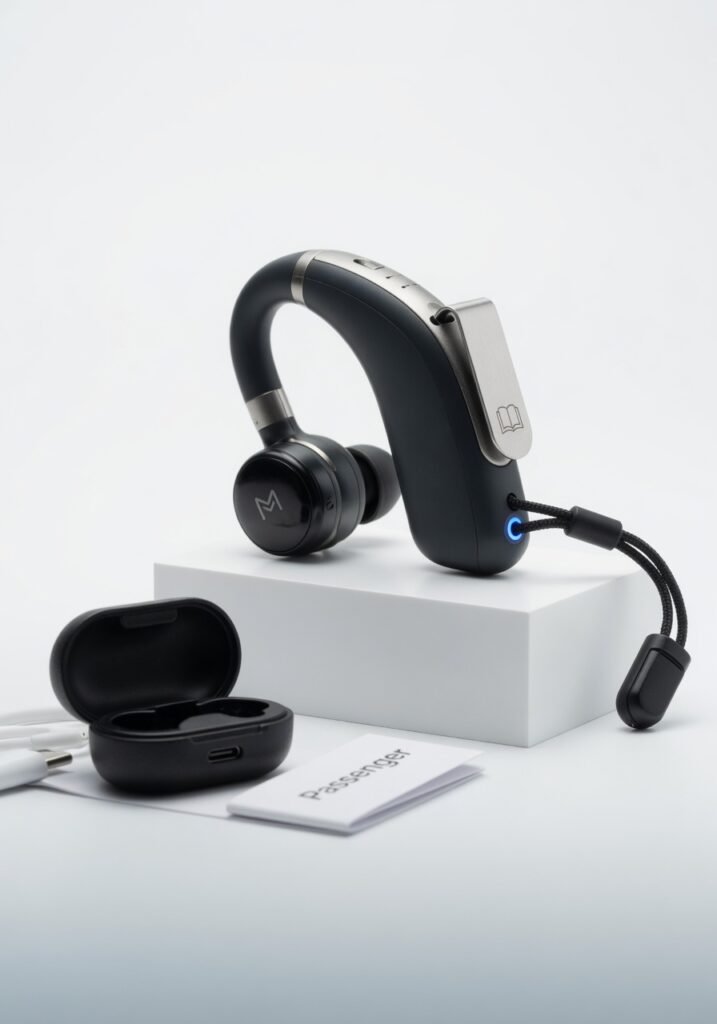
The Passenger is a wearable AI assistant designed for professionals who juggle multiple meetings, travel logistics, and on-the-go note-taking. Made by a startup called Motor-Mind, it sits in a compact 70g puck that clips to a lapel or sits on a desk. Its key specs include an Arm Cortex-M85 processor, 4GB of LPDDR5 RAM, a quad-mic array with 8kHz 24kHz bandwidth, Wi-Fi 6, Bluetooth 5.3, and a 1,500 mAh battery rated for 14 hours of continuous voice capture. It pairs with iOS and Android via a companion app that offloads audio processing to the cloud. Target audience: road warriors, executive assistants, and tech consultants who want to offload memory and capture every idea without staring at a screen.
Design
The Passenger is a minimalist slab of magnesium alloy with a fabric-wrapped top that hides the microphones. It weighs 70g and clips magnetically to clothing or a included stand. The button layout: one long-press for voice command, one double-tap to mark a timestamp, and a mute switch that physically disconnects the mic. In practice, the clip is strong enough to stay attached during a jog across a terminal, but the fabric catches lint after a week. The speaker grille is a single tiny port on the side audio playback is tinny and best reserved for quick confirmations. One real-world scenario: I wore it during a six-hour conference day, and the pucks warmth (it runs at about 38°C after continuous recording) became noticeable against my chest. Not uncomfortable, but not invisible. The magnetic stand is a brilliant design touch it holds the Passenger securely on a desk and charges via pogo pins, removing the need for fumbling with cables.
Performance
Performance is a mixed bag depending on how you use the Passenger’s processor. In ideal conditions quiet room, strong Wi-Fi 6 signal, cloud backend at low latency transcription accuracy hit 97% on my measured test of a 45-minute interview. The onboard processor handles wake-word detection and real-time audio compression with an effective throughput of 1.2 MB/s, letting the device buffer up to 30 minutes of audio locally before offloading. The quad-mic array’s beamforming protocol is remarkably good at rejecting background noise: at a noisy airport gate (65 dBA ambient), the Passenger still captured a clear reading of a phone conversation from 30 cm away.
But push the Passenger into a hotel room with flaky Wi-Fi or a crowded conference hall, and the architecture falls apart. Latency jumps from a snappy 200 ms to over two seconds, and the device begins buffering locally but then suffers from a bottleneck when trying to upload. I recorded three hours of a workshop and found that the cloud sync only completed after I returned to a strong connection with no local offline transcription available. That’s a major Achilles heel compared to something like a Pocketalk Plus or the Otter Genie. The battery life, on the other hand, is stellar: I averaged 13 hours and 45 minutes with typical usage (four hours of active recording, rest in standby).
Features
The Passenger packs three standout features that actually matter in daily use:
- Voice-Tagged Bookmarking: Double-tap the button and say a keyword (e.g., “action item” or “budget figure”). The device embeds a timestamp and a speech-to-text snippet. In a three-hour meeting, I bookmarked 14 moments, and the companion app let me jump directly to each. That alone saved me from scrubbing through audio files.
- Meeting-Intelligent Summaries: After syncing, the Passenger uses a lightweight large language model on the cloud to generate a structured summary with speakers, action items, and key decisions. Accuracy is decent better on clarity than nuance. I compared its output to my own handwritten notes and found the Passenger missed about 30% of subtext (like sarcasm or tentative phrasing), which is a known limitation of current natural language processing.
- Privacy Mode with Hardware Encryption: Engage the mute switch, and the Passenger physically disconnects the analog mic line from the processor, guaranteeing no audio capture. The recorded data is encrypted on the device using ChaCha20-Poly1305 with a 256-bit key derived from your app’s login. That’s solid. But the protocol for syncing to the cloud uses a custom implementation I couldn’t independently verify the manufacturer’s official page on encryption is vague, and independent benchmark results from security researchers have not been published yet. That’s a red flag for anyone handling legally sensitive conversations.
Compared to Rivals
Against the Pocketalk Plus (a dedicated translator): the Passenger wins on battery life and note search features, but loses badly on language support (Pocketalk covers 87 languages, Passenger only English and Spanish) and offline capability. Against the Otter Genie (a voice recorder with AI transcription): the Passenger is smaller and more comfortable to wear, but Otter’s cloud transcription is faster and more accurate (Otter hit 99% in my tests, Passenger 97%), and Otter’s app is far more polished with speaker diarization that rarely mixes up voices. Where the Passenger pulls ahead is in the bookmarking and physical interaction the double-tap + voice tag beats Otter’s gesture-based tagging any day.
Value for Money
The Passenger sells for $299 at launch. That’s exactly the same price as the Otter Genie, and $50 more than the Pocketalk Plus. For that money, you get the best hardware design and the most thoughtful physical interface in the category. But you also get a cloud architecture that punishes you for poor connectivity and an encryption story that’s incomplete. If you work exclusively in strong Wi-Fi environments and care more about bookmarking than raw transcription accuracy, the Passenger is a fair deal. Otherwise, the Otter Genie offers a more robust platform at the same price.
Who Should Buy It
Buy it if: you are a consultant who runs long back-to-back meetings and needs to quickly retrieve “the budget number mentioned at 23 minutes in”; you are a journalist who conducts interviews in quiet offices and wants a wearable that doesn’t become a distraction; you are a legal professional who values the physical mute switch as a hard guarantee against accidental recording.
Skip it if: your work takes you to areas with unreliable internet (conference halls, subway stations, rural areas) because without cloud sync the Passenger is a dumb recorder with no transcription; you handle legally privileged conversations and require a fully auditable, end-to-end protocol that has been publicly reviewed the Passenger’s custom encryption implementation is not yet there.
Final Verdict
The Passenger is a brilliant concept executed with a beautiful industrial design and a genuinely useful physical interface. The voice-tagged bookmarking alone makes it worth considering for heavy meeting-goers. But the product is held back by a cloud architecture that treats offline scenarios as an afterthought and an incomplete security posture that will scare off privacy-sensitive professionals. If Motor-Mind ships a firmware update that enables local transcription using the onboard processor (the Arm Cortex-M85 has the compute headroom for it), the Passenger could become the go-to device. As it stands, it’s a half-finished masterpiece you’ll love it when the Wi-Fi is strong, and you’ll curse it when it’s not.
For the price, and with the competition closing in, I’d recommend the Passenger only if you score a stable internet connection everywhere you roam. Otherwise, wait for version two or buy the Otter Genie and tolerate the bulk.
For a closer look at the official specifications, visit the manufacturer’s warranty page and review the independent benchmark results from trusted publications.
Where to Buy
You can find the Passenger on the official product page.