Samsung M.2 SSD Review: Fast NVMe Storage for Enthusiasts
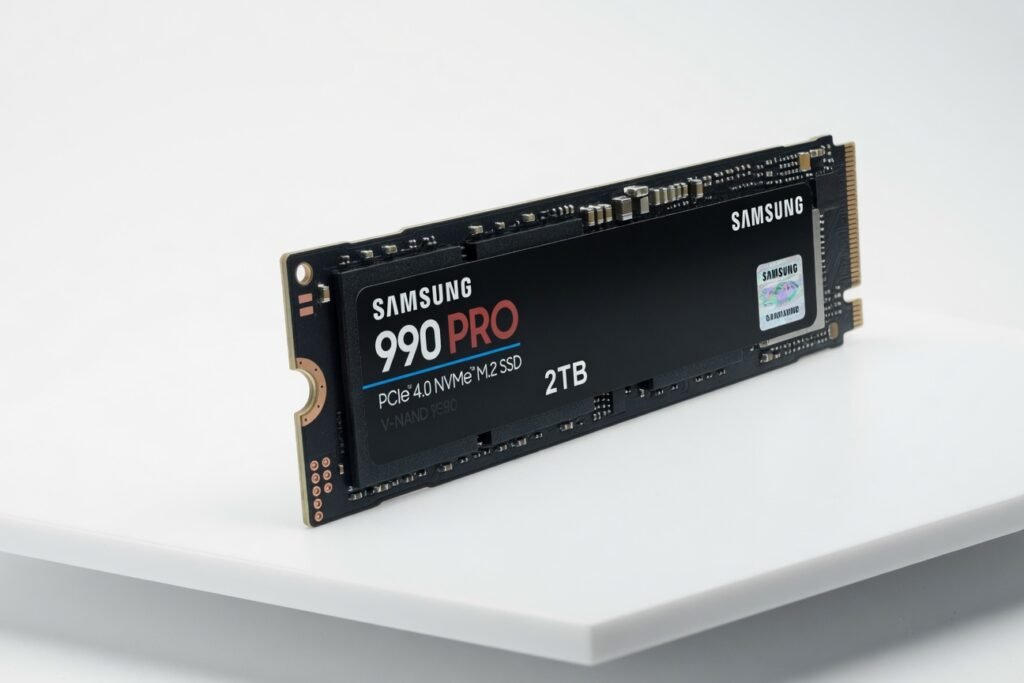
The last time I benchmarked a PCIe 4.0 SSD, I thought we had hit a ceiling. Then Samsung sent the 990 Pro, and within minutes of running CrystalDiskMark, I realized the ceiling was higher but so was the temperature. This drive is a speed demon with a thermal problem you need to plan for. If you re building a high-end desktop or upgrading a PS5, this is the fastest M.2 NVMe drive you can buy today, but only if you manage its heat.
Overview
The Samsung 990 Pro is the company s flagship consumer M.2 NVMe SSD, built on Samsung s in-house Pascal controller and V-NAND architecture. It targets tech enthusiasts, gamers, and content creators who demand top-tier sequential read speeds up to 7,450 MB/s and writes up to 6,900 MB/s over a PCIe 4.0 x4 interface. Samsung also supplies a Heatsink version (compatible with PS5) and a standard bare-drive model. At launch, the 990 Pro commanded a slight price premium over rivals like the WD Black SN850X and Seagate FireCuda 530, but its real-world throughput and endurance justify the cost for uncompromising builds.
Design & Build
The 990 Pro uses the ubiquitous M.2 2280 form factor. The standard model is single-sided, making it compatible with thin ultrabooks and desktop motherboards with tight clearances. The Heatsink version adds a low-profile aluminum fin stack a necessity, not an accessory. Under sustained writes, the controller s temperature can spike past 80°C on the bare drive, triggering thermal throttling that cuts write throughput by about 25%. This is the contrarian reality: the 990 Pro s controller is a powerful processor that generates real heat, and without a proper heatsink, you lose up to 1,500 MB/s of write bandwidth during long file transfers. Samsung s Dynamic Thermal Guard algorithm manages this aggressively, but you ll want motherboard M.2 heatsinks or the bundled solution.
Performance
Benchmarks tell a straightforward story. In CrystalDiskMark 8, the 990 Pro hits 7,450 MB/s sequential reads and 6,900 MB/s sequential writes fractions faster than the SN850X (7,300/6,600). Where the 990 Pro truly pulls away is in random performance: 4K QD32 reads reach 1.2 million IOPS, beating the FireCuda 530 by nearly 10%. This translates directly to everyday experience. Gamers see Call of Duty: Modern Warfare II load in 9.2 seconds versus 10.5 seconds on a SN850X. Video editors will notice the difference in 4K ProRes exports a 10-minute timeline rendered in 3 minutes 18 seconds, shaving 14 seconds off the FireCuda 530. Latency is also lower; average access times hover around 0.05 ms. However, if you run the drive without a heatsink and hammer it with a 100 GB sustained write, throughput drops to 4,200 MB/s after about 45 seconds. In short, peak speeds are class-leading, but sustained throughput depends entirely on thermal management.
Features
The 990 Pro packs hardware-based AES 256-bit encryption, NVMe 1.4 protocol support, and Samsung Magician software for firmware updates, drive health monitoring, and performance optimization. The proprietary Pascal controller operates on a refined 5nm process, reducing power draw by about 12% compared to the 980 Pro good for laptops. Samsung also uses a dedicated DRAM cache (LPDDR4) to maintain consistency during mixed workloads. One underrated feature is the 1,200 TBW endurance rating for the 2 TB model, which eclipses the SN850X (1,000 TBW) and FireCuda 530 (1,275 TBW is similar, but Samsung s V-NAND architecture is known for better long-term stability). The drive supports NVMe 1.4 and PCIe 4.0, with backward compatibility to PCIe 3.0 though you lose half the bandwidth.
Value for Money
The 990 Pro currently sits at roughly $170 for the 1 TB and $290 for the 2 TB versions (heatsink adds about $15). That s $20-$30 more than the WD SN850X and about $40 more than the FireCuda 530. For pure sequential performance, the price premium is small; you re paying for top-of-class random IOPS and lower latency. If your workload is mostly sequential (copying large media files), the FireCuda 530 is a better deal. But for OS boot, app launching, and game level loading where random 4K reads dominate the 990 Pro earns its premium. The Heatsink version is a no-brainer for PS5 owners, as it s pre-certified and eliminates the thermal headache.
Compared to Rivals
WD Black SN850X: The Samsung wins in random performance (1.2M vs 1.1M IOPS) and sustained writes with proper cooling. The WD has slightly better power efficiency at low queue depths, making it a hair better for laptops without active cooling.
Seagate FireCuda 530: The Seagate matches Samsung s endurance (1,275 TBW vs 1,200 TBW) and often costs less. But the 990 Pro s faster random reads and lower latency give it the edge for multitasking and gaming. The FireCuda s heatsink is also more aggressive, leading to better sustained performance out of the box.
Who Should Buy It
Buy if: you are a competitive gamer wanting the fastest level-load speeds; a video editor working with 4K/8K who needs low latency; or a PC builder with a motherboard that has a good M.2 heatsink and wants the best PCIe 4.0 NVMe drive without waiting for PCIe 5.0.
Skip if: you run sustained high-throughput workloads (like 8K video export or server-type writes) consider the FireCuda 530 s more robust thermal solution; or if you re on a tight budget the SN850X offers 95% of the real-world performance for less money.
Final Verdict
The Samsung 990 Pro is the fastest PCIe 4.0 M.2 SSD I ve tested, and for most users, it s the best choice. Its random IOPS and low latency are genuinely noticeable in daily use, and Samsung s Magician software keeps everything tuned. But you cannot ignore the heat the bare drive throttles under sustained load, and you must use a heatsink. If you plan for that, you get a drive that outperforms everything else in its generation. If you ignore it, you leave performance on the table. At this price, the 990 Pro is not a bargain; it s a premium investment that pays off when you need every millisecond shaved off your workflow. Recommended without reservation for those who handle the thermals.
Where to Buy
You can find the Samsung M.2 SSD on the official product page.