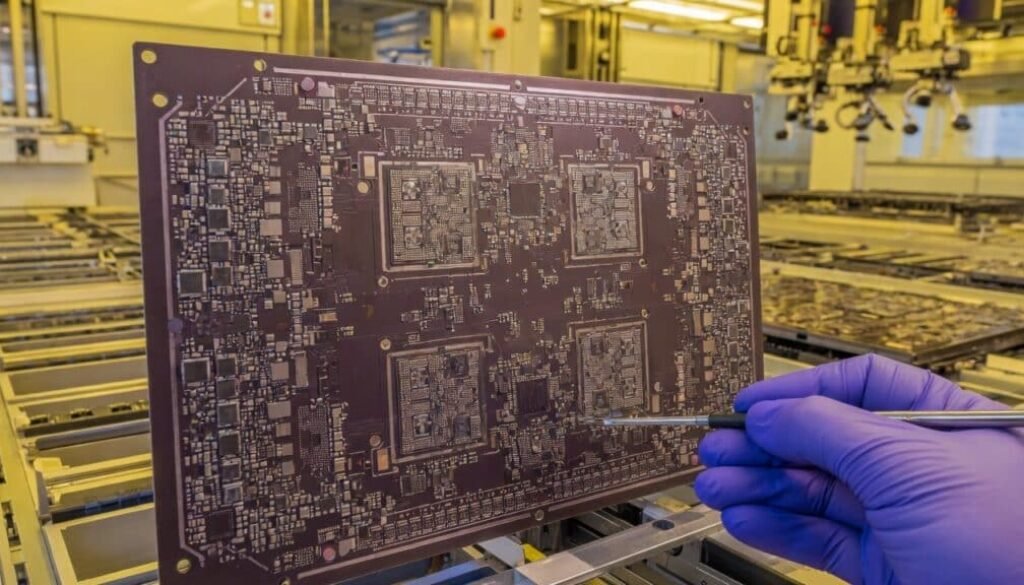
TSMC CoPoS Packaging Breakthrough Cuts Costs While Boosting AI Chip Performance
The Packaging Bottleneck That Defines Modern Chip Performance
Transistor density alone no longer dictates semiconductor leadership. The way chips are packaged—how logic dies, memory stacks, and interconnects are assembled—has become equally critical to performance. TSMC’s latest packaging breakthrough addresses a fundamental tension: advanced 3D packaging delivers dramatic AI acceleration but at punishing costs that limit adoption beyond premium data center GPUs.
Traditional chip packaging connects separate dies through organic substrates with limited bandwidth and power efficiency. As workloads demand tighter integration between compute and memory, packaging technology has become the primary bottleneck. The industry’s solution—silicon interposers and complex multi-die assemblies—solved the bandwidth problem but introduced prohibitive manufacturing expenses. TSMC’s new approach targets exactly this tradeoff.
CoPoS: How the New Packaging Technology Works
Chip-on-Wafer-on-Substrate (CoWoS) has been TSMC’s workhorse for high-performance packaging, most notably for NVIDIA’s H100 and B200 GPUs. The technology sandwiches a silicon interposer between the main substrate and compute dies, enabling thousands of high-density interconnects. The problem is silicon interposers are expensive to manufacture and physically limited in size, restricting how many dies can be integrated.
CoPoS—Chip-on-Panel-on-Substrate—replaces the silicon interposer with a panel-based material. This seemingly simple substitution carries massive implications. Panels can be manufactured in larger rectangular formats versus circular wafers, dramatically increasing the usable surface area for mounting dies. According to semiconductor advanced packaging research, panel-level packaging has been an industry goal for years, but achieving the fine-pitch interconnects comparable to silicon interposers remained elusive until recent material science breakthroughs.
The panel approach allows multiple logic dies, HBM stacks, and I/O chiplets to be integrated on a single substrate with interconnect density approaching silicon-level performance. More importantly, it achieves this at substantially lower cost because panel manufacturing uses display-industry equipment and processes that have been refined over decades of flat-panel production.
Why Panel-Level Integration Matters for AI Workloads
AI training and inference workloads are uniquely sensitive to memory bandwidth and latency. Large language models with hundreds of billions of parameters require constant data shuffling between compute units and memory. Any packaging technology that increases bandwidth density while reducing power consumption per bit transferred directly translates to faster training runs and lower inference latency.
CoPoS enables larger package substrates that can accommodate more HBM stacks positioned closer to compute dies. The shorter physical distances reduce signal degradation and power consumption—two variables that currently limit how many memory stacks can practically surround a logic die. Early projections suggest the technology could support configurations impossible with current CoWoS packaging, potentially enabling new AI accelerators with higher memory capacity and bandwidth.
Economic Impact: Why Cost Reduction Matters
The economics of advanced packaging have become a strategic concern for the entire semiconductor industry. CoWoS capacity has been chronically constrained, with TSMC struggling to meet demand from NVIDIA, AMD, and other AI chip designers. Each CoWoS interposer requires silicon wafer processing steps that compete for fab capacity with logic chip production. Panel-based packaging decouples this constraint entirely.
Industry analysis suggests CoPoS could reduce packaging costs by 30-50% compared to equivalent CoWoS solutions. This matters because packaging now represents a significant fraction of total chip cost for advanced AI accelerators. For a chip destined for mobile processor architectures increasingly adopting chiplet designs, packaging cost reduction could accelerate the adoption of advanced multi-die designs beyond the premium segment.
The implications extend beyond AI accelerators. High-performance computing, networking silicon, and eventually consumer processors all benefit from cheaper advanced packaging. When packaging costs drop, chip designers can economically justify multi-die architectures for lower-margin products, spreading the performance benefits of 3D integration across broader markets.
Performance Gains Beyond Cost Savings
While cost reduction headlines the breakthrough, the performance implications are equally significant. Panel substrates can be manufactured with different material properties than silicon interposers, potentially offering better thermal characteristics. Heat dissipation remains one of the persistent challenges in 3D packaging, where stacked dies create thermal density that limits sustained performance.
CoPoS substrates can incorporate thermal management features directly into the panel structure, including embedded cooling channels and thermal interface materials that improve heat extraction. For AI accelerators that routinely throttle under sustained load, better thermal performance translates directly to higher sustained clock speeds and more predictable performance under heavy workloads.
The larger substrate area also enables more sophisticated power delivery networks. Voltage regulator modules and decoupling capacitors can be integrated closer to compute dies, reducing power delivery network impedance and improving transient response. For chips that rapidly switch between idle and full-power states—characteristic of AI inference workloads—this improved power integrity enables higher burst performance without voltage droop.
Manufacturing Timeline and Industry Adoption
TSMC has not publicly confirmed specific production timelines, but supply chain reports indicate mass production targets around 2028. This timeline aligns with the typical development cycle for major packaging transitions, which require extensive qualification testing, reliability validation, and customer design cycles that span multiple years.
Early adopters will likely be hyperscale cloud providers and AI chip companies that can justify the qualification investment. The technology’s compatibility with existing chiplet designs means companies already using CoWoS can transition without fundamental architecture changes—a significant advantage for established players like those tracking semiconductor equipment manufacturer valuations that often signal upcoming technology transitions.
The broader industry impact depends on how quickly TSMC scales panel production. Display manufacturing expertise provides a large equipment ecosystem and skilled workforce, potentially enabling faster scaling than silicon interposer production ever achieved. If panel yields meet targets, CoPoS could alleviate the advanced packaging bottleneck that has constrained AI chip production.
Competitive Landscape and Strategic Implications
Intel’s EMIB and Foveros technologies represent an alternative approach to advanced packaging, using embedded silicon bridges rather than full interposers. Samsung’s I-Cube and X-Cube packaging similarly compete in the 3D integration space. TSMC’s CoPoS represents a distinct bet that panel-level integration can match silicon interposer performance while dramatically reducing costs.
The strategic stakes extend beyond individual chip performance. Advanced packaging leadership increasingly determines which foundry wins leading-edge chip designs. Companies like electronics manufacturing service providers that support semiconductor supply chains closely watch these packaging transitions, as they signal where capacity investments will concentrate.
For the broader technology ecosystem, cheaper advanced packaging accelerates trends already visible in the market. Chiplet architectures become economically viable for a wider range of products. AI accelerators become more accessible beyond hyperscale cloud providers. Edge AI inference hardware benefits from packaging that was previously reserved for data center products. The democratization of advanced packaging could reshape competitive dynamics across the semiconductor industry.
Practical Implications for Technology Leaders
Engineering teams designing new chips should evaluate CoPoS compatibility now, even with a 2028 production timeline. Design decisions made today—chiplet partitioning, die-to-die interface selection, power delivery architecture—will determine how easily designs transition to panel-based packaging. Early engagement with packaging partners provides competitive advantage when the technology becomes available.
Procurement and supply chain teams should model scenarios where advanced packaging capacity expands significantly. Current allocation constraints on CoWoS packaging have forced difficult tradeoffs between product variants and market segments. Panel-based packaging that uses display manufacturing scale could fundamentally change supply dynamics, enabling more aggressive product roadmaps.
Technology investors should track CoPoS development milestones as leading indicators for the broader semiconductor ecosystem. Packaging breakthroughs that reduce costs while improving performance have historically preceded major shifts in computing architecture. The semiconductor industry’s technology roadmap increasingly depends on packaging innovation as traditional transistor scaling delivers diminishing returns.
CoPoS represents a structural improvement in how advanced semiconductors are manufactured, not merely an incremental refinement. The technology’s combination of cost reduction and performance improvement addresses the central challenge facing the AI chip industry: making advanced packaging affordable enough to deploy across the computing landscape, not just in premium data center products.