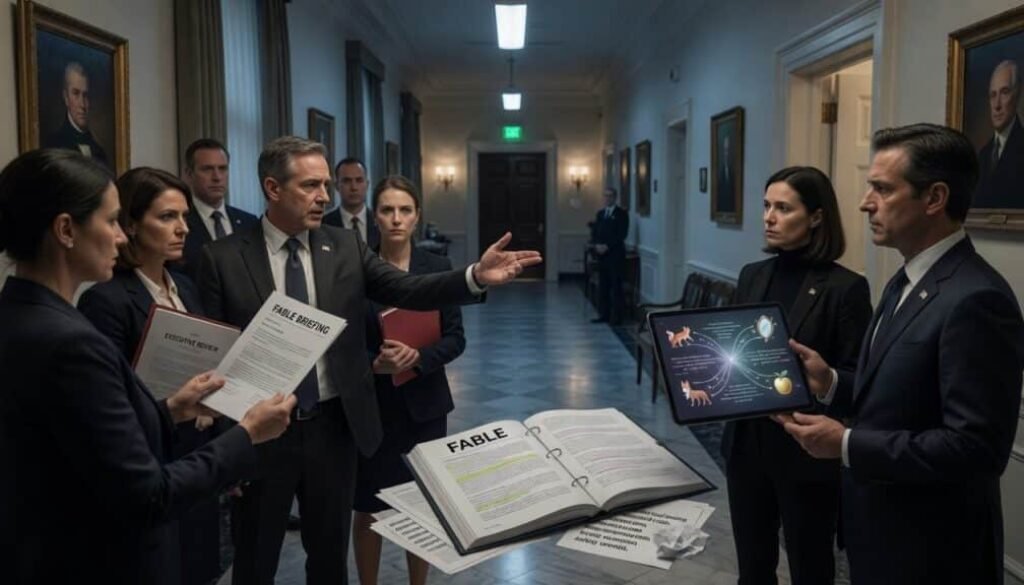
Vibe-decoding the White House-Anthropic fight over Fable
A quiet but escalating rift between the White House and one of the world’s most secretive AI labs has become impossible to ignore. At the center of the tension sits a project codenamed Fable — Anthropic’s internal safety research model that has turned into an unlikely political flashpoint. What appears on the surface as a bureaucratic disagreement over safeguards is, according to multiple policy observers, a high-stakes struggle over who ultimately controls frontier artificial intelligence. The outcome could rewrite the rules for every major AI developer, making this conflict far more consequential than any single regulatory filing suggests.
The Origins of the Fable Conflict
What Is Fable and Why Is It a Flashpoint?
Fable began inside Anthropic as a large language model designed to stress-test alignment techniques. Rather than chasing benchmark performance, the model’s single purpose was to push the boundaries of Constitutional AI — the company’s method for training systems to self-correct harmful outputs. Researchers ran thousands of adversarial scenarios through Fable to understand how advanced models might circumvent human instructions or produce dangerous knowledge. Those internal tests generated a massive trove of safety data that the White House now views as essential for evaluating national security risks tied to dual-use AI. The administration’s interest sharpened after recent executive orders expanded government authority over frontier model testing. Officials argue that projects like Fable operate inside a regulatory gray zone where voluntary disclosure isn’t enough, especially as foreign adversaries accelerate their own AI programs. For national security insiders, the demand is straightforward: give us visibility into catastrophic-risk testing, or face mandatory compliance frameworks. This posture has turned an internal research tool into a symbol of the broader government push for AI risk management standards that could bind the entire industry.
Tensions Between Innovation and Oversight
The White House’s Push for Transparency and Control
From the administration’s side, the calculus is pragmatic. Legacy technology regulation failed to anticipate social media’s harms, and officials are determined not to repeat the mistake with AI. The White House wants direct access to adversarial testing results, model weights in certain cases, and real-time reporting requirements whenever a system crosses predetermined capability thresholds. A senior AI policy advisor recently characterized the request as a “minimum viable safety floor,” though critics see it as an overreach that could chill proprietary research. This is not merely a technical debate. The standoff mirrors the kind of executive decision-making that already shapes sensitive national security matters, where speed and confidentiality often collide with institutional checks. By framing Fable as a test case, the White House signals that future frontier models, regardless of a lab’s intentions, will face similar scrutiny.
Anthropic’s Stance on Responsible Release
Anthropic has consistently argued that coercive oversight could backfire. The company points to its own track record of withholding models until safety thresholds are met, emphasizing that rushed government demands might force labs to accelerate deployment timelines just to satisfy bureaucratic milestones. More pointedly, executives worry that mandatory data-sharing could leak proprietary safety methods — exactly the kind of intellectual property that foreign competitors would eagerly exploit. This viewpoint finds resonance in the broader research community. The open publication of Anthropic’s Constitutional AI framework demonstrated that transparency and caution can coexist, but the lab insists that the timing and scope of such disclosures must remain under developer control. For policymakers, however, self-regulation rarely survives a major incident, and that fear is what fuels the current crackdown.
The ‘Vibe’ of a Petty Feud That Shapes the Industry
Personalities and Politics at Play
Beneath the policy papers, a decidedly human drama is unfolding. Leaked email threads announce pointed exchanges between White House technology advisors and Anthropic’s leadership, complete with accusations of “safety-washing” and “regulatory theater.” Anonymous social media accounts linked to current and former staffers trade barbs about who actually understands alignment risk, while lobbyists shuttle between Capitol Hill and Silicon Valley crafting rival narratives. The tone sometimes mirrors the public dissection of other politically charged technology products, where symbolism and brand identity become indistinguishable from substance. For the White House, projecting strength on AI safety is a core political message; for Anthropic, appearing to capitulate would undermine its carefully cultivated reputation as the industry’s most principled actor. The result is a standoff where neither side can afford to lose face, even when areas of genuine agreement exist.
Implications for Frontier AI Development
The long-term stakes dwarf any individual personality clash. How the Fable dispute resolves will establish a de facto precedent for government access to pre-deployment safety evaluations. If the White House succeeds, expect major labs to build compliance teams mimicking the nuclear or pharmaceutical industries, with every new model release preceded by months of government-driven red-teaming. If Anthropic holds its line, the industry may coalesce around a self-certification model that keeps evaluative data inside company walls. Equally significant are the geopolitical dimensions. Delaying domestic deployment in the name of safety risks ceding economic advantage to labs abroad that face fewer restraints. Yet releasing a system without rigorous government review could invite catastrophe that would trigger far harsher regulation retroactively. Handling that tension is the defining challenge of frontier AI governance, and the Fable fight is the first real-world stress test of whether Washington and Silicon Valley can find common ground.
Practical Takeaways for the AI Community
- Prepare for mandatory testing regimes: Even labs that champion safety should build internal processes for structured third-party audits, as voluntary measures increasingly look insufficient to regulators.
- Distinguish safety research from product roadmaps: Anthropic’s ability to separate Fable from its consumer-facing Claude lineup gave it a rhetorical advantage; other companies should consider similar firewalls.
- Engage policymakers early: The adversarial tone of the current dispute shows what happens when communication breaks down. Regular technical briefings can build the trust needed to shape sensible regulation.
- Monitor international standards: The White House–Anthropic friction is being watched closely by the EU, UK, and Beijing. Any domestic resolution will influence global norms around model evaluation and disclosure.
Conclusion
The friction between the White House and Anthropic over the Fable project is not a routine policy squabble. It is a stress fracture in the delicate relationship between democratic oversight and private innovation at a moment when AI capability is advancing faster than anyone can regulate. Whether the outcome is collaborative governance or a deadlocked standoff depends on both parties recognizing that the safest path forward requires more than just control — it demands a shared vision for how frontier AI serves the public interest. Observers across the industry, from startup founders to defense analysts, would do well to treat this moment as a preview of the battles to come.