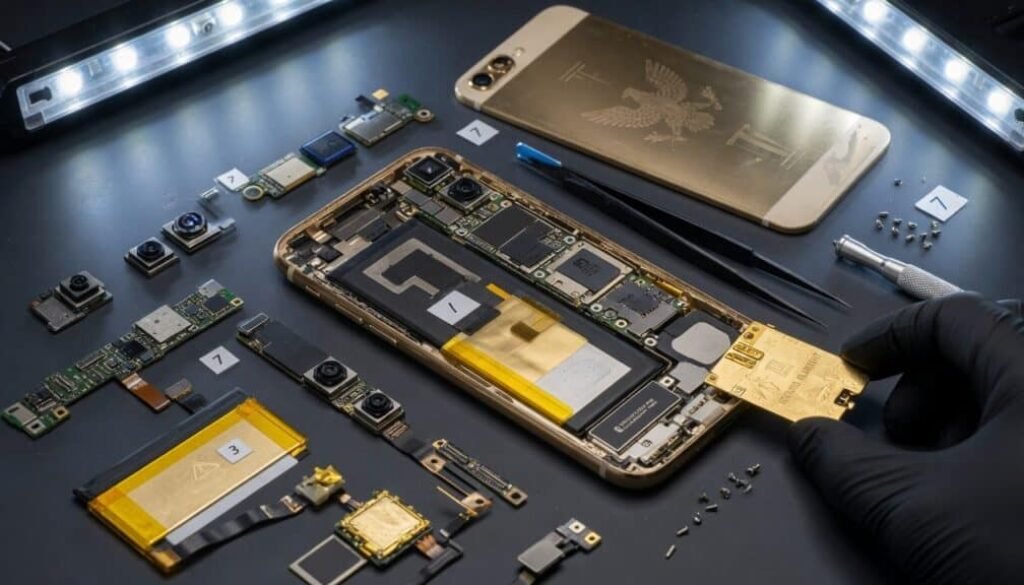
What’s Really Inside Trump’s Gold Smartphone? A Teardown Has Answers
The Trump T1 gold smartphone arrived with bold branding and a premium price tag, but its true identity remained a mystery—until a careful teardown peeled back the layers. A detailed hardware analysis has uncovered that beneath the gold exterior, the device shares nearly identical internal architecture with a mid-range handset from a veteran manufacturer. The findings raise serious questions about the product’s value proposition and its engineering origins.
The Trump T1 Teardown: Introducing the Internal Components
A professional disassembly performed by iFixit announced that the Trump T1 is not a ground-up custom design. The process began with heating the rear panel to loosen the adhesive, announcing a layout that immediately felt familiar to seasoned repair technicians. The motherboard placement, battery shape, and even the flex cable routing mirrored a device that had already been on the market. The battery, a 4,600 mAh lithium-polymer cell, sits in the same position and uses the same connector as a well-known competitor. This level of component reuse is rare in devices marketed as exclusive luxury items. The teardown also exposed a Snapdragon 7 Gen 3 processor, 12 GB of LPDDR5 RAM, and 256 GB of UFS 3.1 storage—specifications that align precisely with a phone released months earlier by a different brand. For consumers concerned about longevity, such internal transparency matters. Understanding what lies inside a device can help predict repair costs and software support. Those interested in battery health assessment methods will find that the Trump T1’s power management IC is identical to the one used in the HTC U24 Pro, meaning diagnostic tools developed for that model can be applied here as well.
Striking Similarities to the HTC U24 Pro
The most startling revelation is the component-level parity with the HTC U24 Pro. From the camera sensor array to the vibration motor, the parts list reads like a carbon copy. The main 50-megapixel rear camera uses the same Sony IMX890 sensor, the 8-megapixel ultrawide module is unchanged, and even the 50-megapixel front-facing camera sits behind an identical punch-hole cutout. The display assembly also matches: a 6.8-inch OLED panel with a 120 Hz refresh rate and an under-display fingerprint scanner. The teardown confirmed that the display connector and driver IC are interchangeable between the two devices. This level of hardware mirroring goes far beyond simple component sourcing; it suggests a full platform reuse. According to HTC U24 Pro official specifications, that device launched with the same Snapdragon 7 Gen 3 chipset, identical memory configurations, and the same 4,600 mAh battery. The Trump T1’s gold-plated chassis is the only meaningful physical differentiator. All internal brackets, thermal pads, and antenna bands are placed exactly where they are on the HTC device. This kind of hardware cloning is not illegal, but it does obscure the value equation. When a luxury-branded phone shares its core engineering with a mid-range handset, the premium markup becomes difficult to justify. The teardown also highlighted that the Trump T1 uses the same cooling solution—a modest vapor chamber—that struggles under sustained load in the original HTC model.
What This Announces About the Phone’s Origins
The evidence points to a classic case of common rebadging strategies in the electronics industry, where a manufacturer licenses an existing design and applies new branding and cosmetic changes. In this scenario, the Trump T1 appears to be a white-label version of the HTC U24 Pro, produced by the same ODM (original design manufacturer) and then customized with a gold finish and exclusive software skin. This practice is widespread in the smartphone market, particularly among brands that lack in-house R&D capabilities. However, it is rarely disclosed to consumers. The teardown effectively forces transparency, showing that the device’s intellectual property and hardware development originated entirely outside the Trump brand. For those following smartphone market trends, this discovery underscores how quickly new entrants can launch products by using existing platforms. The Trump T1’s launch timeline—from announcement to retail—was remarkably short, a feat made possible only because the engineering work had already been completed by HTC’s team.
Implications for Buyers and the Luxury Smartphone Market
The teardown’s findings carry practical consequences. First, repair parts for the Trump T1 will likely be interchangeable with HTC U24 Pro components, which could simplify maintenance—if the gold chassis does not hinder access. Second, software updates may depend on the underlying HTC firmware support cycle, not on Trump’s own development team. The luxury phone segment has often relied on exclusivity and perceived uniqueness. When a teardown announces that a $1,200 gold device shares its motherboard with a $600 phone, the luxury narrative collapses. Savvy buyers now have a concrete benchmark for evaluating the true hardware cost. Learning how to read teardown reports has become a valuable skill for anyone investing in high-priced electronics. Resources that explain digital teardown techniques can help consumers identify rebadged products before making a purchase. The Trump T1 case serves as a textbook example of why internal inspection matters just as much as external design. The gold plating itself adds weight and aesthetic appeal but contributes nothing to performance. The device’s real-world benchmarks, thermal behavior, and camera output will be indistinguishable from the HTC U24 Pro. For collectors, the branded exterior may hold value; for everyday users, the teardown confirms they are paying a premium for a mid-range experience wrapped in gold.
Key Takeaways from the Trump T1 Teardown
- Hardware is identical to the HTC U24 Pro: Every major component, from the SoC to the camera sensors, matches exactly, confirming a full platform reuse.
- The gold finish is cosmetic only: There is no structural reinforcement or upgraded thermal management to justify the price difference.
- Repair and support paths align with HTC: Parts availability and software updates will likely follow HTC’s lifecycle, not a proprietary Trump schedule.
- Transparency comes from independent analysis: Official marketing did not disclose the HTC origins; only a teardown brought the truth to light.
- Luxury branding does not equal engineering innovation: The device is a rebadged mid-ranger, a fact that reshapes its perceived value.
The Trump T1 gold smartphone teardown demonstrates that even the shiniest exteriors can hide ordinary internals. As the smartphone industry continues to see new brand launches, independent hardware verification will remain the most reliable way to separate genuine innovation from clever rebranding. For consumers, the lesson is clear: always look beneath the surface before buying into the hype.