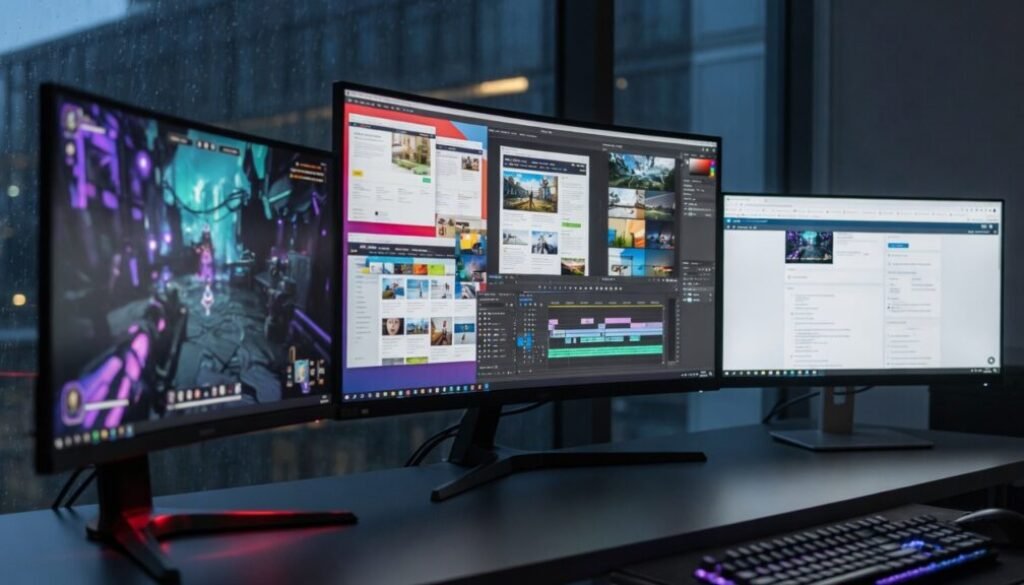
Ultrawide Monitor Buyer’s Guide: Best Picks for Gaming, Budget & 5K
After decades of cramped spreadsheets and awkward bezel gaps between dual monitors, ultrawide displays have evolved from a niche enthusiast product into a mainstream productivity and gaming tool. A single 34-inch or 49-inch curved panel delivers roughly the same horizontal pixels as two standard monitors, but without the divider slicing across the center. This guide examines the best ultrawide monitors on the market today, breaking down picks for gaming, budget-conscious buyers, creative professionals needing 5K resolution, and every use case between.
Understanding Ultrawide Resolutions and Aspect Ratios
Not all ultrawide monitors are created equal. The most common aspect ratio is 21:9, which provides a 2560×1080 or 3440×1440 resolution. The newer super-ultrawide category uses a 32:9 ratio, essentially the equivalent of two 16:9 monitors side by side at 3840×1080 or 5120×1440. Panel curvature also varies — typically 1500R to 3800R — with tighter curves offering more immersive wrap-around visuals but requiring more desk depth.
Resolution determines sharpness and the type of tasks a monitor can handle well. For pure gaming, a 3440×1440 panel strikes an excellent balance between detail and frame-rate demands. For photo editing and video production, a 5K2K or 5120×2160 display delivers the pixel density needed for 4K timeline views and precise color grading without zooming. Learn how ultrawide aspect ratios originated in cinema and why they translate so well to desktop computing.
Gaming Ultrawides: High Refresh Rates and Immersive Field of View
Competitive and single-player gamers alike benefit from the expanded peripheral awareness an ultrawide provides. In racing or flight simulators, the wider canvas fills natural vision more completely than a standard 16:9 display. For first-person shooters, having a 34-inch or 49-inch screen means enemies entering from the side appear earlier, giving a split-second advantage.
Refresh Rate and Adaptive Sync Essentials
A gaming ultrawide should offer at least 120 Hz refresh rate, but 144 Hz or 165 Hz is becoming standard on mid-range models. Adaptive sync technologies like FreeSync Premium Pro and G-Sync Compatible eliminate screen tearing without the performance penalty of V-Sync. For the smoothest experience, look for a monitor that combines a high refresh rate with a fast response time (1 ms to 4 ms). When pairing the monitor with a powerful rig, consider the ASUS ROG Zephyrus Duo’s dual-screen approach as an alternative to a single ultrawide — each setup has trade-offs in bezels versus seamless width.
- Recommended GPU tier: A 3440×1440 ultrawide requires roughly 70% more pixels than 1920×1080, so an RTX 4070 or RX 7800 XT is the baseline for high-refresh gaming.
- Panel type: IPS and VA dominate gaming ultrawides. OLED ultrawides offer perfect blacks and 0.03 ms response but cost significantly more.
Budget Ultrawides: Affordable Screen Real Estate
A common misconception is that all ultrawide monitors cost over $800. Entry-level models with 2560×1080 resolution and 75 Hz refresh rates now land around $250–$350. These monitors are ideal for office productivity, light photo editing, or casual gaming where absolute motion clarity isn’t critical.
Look for a VA panel at this price point — it provides better contrast ratios than budget IPS panels, making blacks look deeper and text more readable. Connectivity should include at least HDMI 2.0 and DisplayPort 1.2. While 75 Hz may not satisfy competitive gamers, it is a noticeable upgrade from the standard 60 Hz office monitor. For those who need absolute color accuracy on a shoestring, the Acer ProCreator PE320QXT delivers pro-level precision under $1,000, though it is not an ultrawide — it shows that budget no longer means sacrificing quality in high-resolution displays.
5K and High-DPI Ultrawides for Creative Professionals
Video editors, photographers, and software developers increasingly choose 5K2K (5120×2160) ultrawide monitors. This resolution, sometimes called “5K Ultrawide,” packs enough pixels to display a 4K timeline with generous toolbars or three 1080p windows side by side at native sharpness. Apple’s XDR displays use a similar density, making these monitors excellent companions for Mac users who rely on Retina-level clarity.
Key specs to seek:
- Color accuracy: Dell U-series or LG UltraFine panels often ship factory-calibrated to Delta E ≤ 2. Support for DCI-P3 (98% or higher) is non-negotiable for video work.
- Connectivity: Thunderbolt 4 or USB-C with 90W+ power delivery simplifies cable management for laptops. A single cable carries video, data, and charging.
- HDR certification: VESA DisplayHDR 600 or 1000 provides the brightness necessary for realistic highlights in HDR content. Read the official VESA DisplayHDR specifications to understand brightness tiers.
Key Features to Compare Before Buying
Beyond resolution and refresh rate, three factors separate a good ultrawide from a great one.
Ergonomics and Desk Fit
A 49-inch monitor requires a desk at least 30 inches deep to avoid eye strain from sitting too close. Height-adjustable stands with tilt and swivel are essential; if the stock stand is limited, budget for a VESA-compatible arm. Curvature rating is also personal — 1500R feels immersive but may distort straight lines for CAD users, while 3800R provides a subtler curve better suited for productivity.
Panel Uniformity and Backlight Bleed
Large VA panels sometimes suffer from darker edges on solid backgrounds, a phenomenon called “vine effect.” IPS panels can exhibit backlight bleed in the corners. Read professional reviews that include uniformity measurements, especially if the monitor is for color-critical work.
Input Lag and Overdrive
For gaming, input lag under 10 ms total (including display processing) is excellent. Overdrive settings should offer multiple levels to balance ghosting and overshoot. Many monitors ship with a “Fast” or “Extreme” mode; the middle setting often provides the best real-world result.
Conclusion
Ultrawide monitors have moved beyond gimmick status to become legitimate tools for productivity and immersion. Whether your priority is a silky-smooth 144 Hz gaming experience, an affordable expansion of desktop space, or a pixel-dense 5K canvas for creative work, there is an ultrawide panel tailored to your needs. Focus on matching resolution to your GPU power, panel type to your visual tasks, and curvature to your workspace depth. By considering these factors, you will end up with a monitor that transforms how you work and play for years to come.